
What Is the Ideal Lighting Budget for Your Home Project?
You’re Investing in Beautiful Finishes. Are You Investing Enough in the Light That Reveals Them?

When homeowners, builders, architects, and interior designers establish a budget for a new home or major renovation, tremendous attention is placed on finishes.
Cabinetry. Flooring. Countertops. Tile. Plumbing fixtures. Appliances. Furniture. Hardware. Paint. Stone.
It isn’t unusual for finishes and finish-related selections to represent a substantial portion of the overall project investment.
Yet lighting—the element responsible for how all of those finishes actually look and feel—can receive only a small fraction of the budget.
Consider a simple budgeting example:
Approximately 60% allocated toward finishes.
Only 2% allocated toward lighting.
That raises an important question:
If you’re willing to invest heavily in what your home looks like, shouldn’t you invest in the light that allows you to see it?
The answer doesn’t necessarily mean dramatically increasing the total project budget.
It may simply require shifting the budget.
Lighting Isn’t Just Another Finish
Lighting is different from almost every other selection in a home because it affects the perception of nearly everything else.
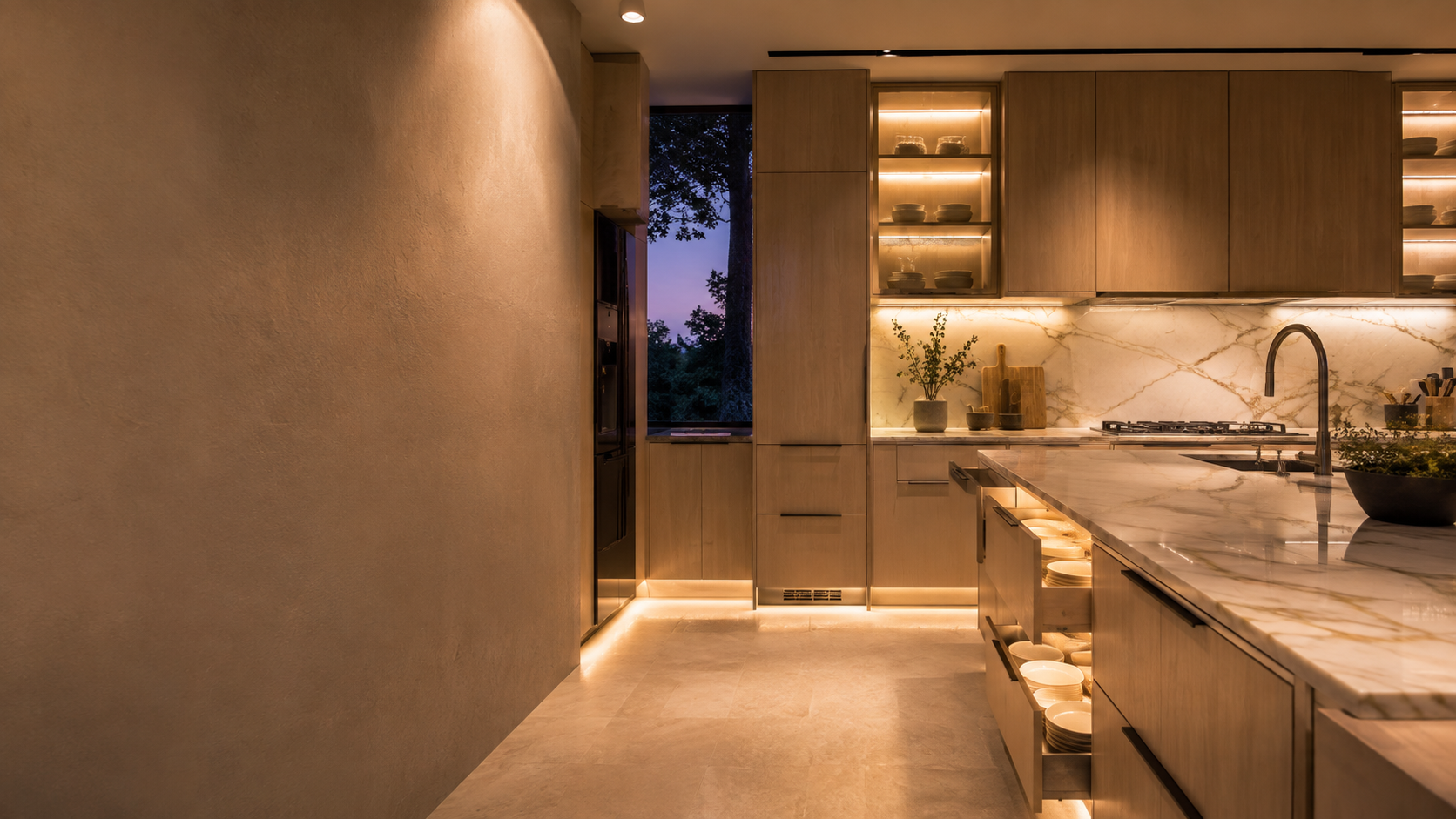
The right lighting can bring out the depth and movement of natural stone.
It can reveal the grain and warmth of custom cabinetry.
It can make wood floors richer, artwork more vibrant, fabrics more dimensional, and architectural details more dramatic.
Poor lighting can do exactly the opposite.
A beautiful countertop under flat or low-quality light can appear lifeless. An expensive paint color can look completely different than expected. A carefully designed room can feel uncomfortable without anyone immediately understanding why.
Great lighting doesn’t compete with great design. It reveals it.
What If You Shifted Just 2–4% More of the Project Budget Toward Lighting?
This is where we encourage homeowners and design professionals to rethink the traditional budget.
Instead of treating lighting as an expense that gets addressed after the finishes have been selected, consider moving an additional 2–4% of the overall project budget toward lighting, lighting control, and lighting design.
Not necessarily adding 2–4%.
Reallocating it.
Imagine a hypothetical $1 million project.
A 2% lighting allocation represents:
$20,000
Increasing that allocation by another 2–4 percentage points would redirect approximately:
$20,000–$40,000 more toward lighting.
The overall project can still be approximately $1 million.
The difference is where the money is working for you.
Instead of spending nearly every available dollar upgrading individual finishes, a portion of that investment can be redirected toward the system that influences the appearance of virtually every room.
The Budget Shift
Think about a project where approximately 60% of the budget is associated with finishes and only 2% with lighting.
What happens if the project team shifts just a few percentage points?
Instead of:
60% Finishes + 2% Lighting
Consider:
56–58% Finishes + 4–6% Lighting
You haven’t fundamentally changed the size of the project.
You’ve changed its priorities.
And that relatively small shift can create opportunities for better:
- Architectural lighting
- High-quality recessed fixtures
- High color-rendering light sources
- Decorative and accent lighting
- Cabinet and millwork lighting
- Linear lighting
- Artwork lighting
- Tunable-white and human-centric lighting
- Intelligent lighting control
- Dimming and scene control
- Automated shades and daylight management
- Professional lighting design and commissioning
The result isn’t simply more light.
It’s better light.
A $1 Million Example
Here’s another way to visualize the decision.
If roughly $600,000 of a hypothetical $1 million project is directed toward finishes and only $20,000 toward lighting, the ratio is enormous.
Now imagine reallocating $30,000 from the finish budget.
You would have approximately:
$570,000 toward finishes
and
$50,000 toward lighting.
The finish budget changed by only 5% of its original amount.
But the lighting budget increased from $20,000 to $50,000.
That’s a completely different lighting conversation.
It may allow the project team to move beyond simply determining where the cans go and begin thinking about layers of light, architectural details, color quality, scenes, controls, daylight, artwork, surfaces, and how the home should feel throughout the day.
Your Finishes Don’t Disappear. They Become More Visible.
This is the important part.
We’re not suggesting that cabinetry, countertops, flooring, tile, furniture, or plumbing fixtures aren’t important.
They absolutely are.
We’re suggesting that there can be a point of diminishing returns.
Would you rather spend another $30,000 upgrading materials that are already beautiful?
Or allocate some of that money toward lighting that improves your experience of every one of those materials, every day?
That is the mindset shift.
Lighting Should Be Designed Alongside the Architecture and Interiors
One of the biggest mistakes we see is waiting too long to discuss lighting.
By the time the electrical walkthrough occurs, many major decisions have already been made.
Ceiling layouts are established.
Cabinetry is designed.
Furniture placement is developing.
Artwork locations may be known.
Stone has been selected.
Yet the lighting plan may still consist primarily of rows of recessed fixtures.
A better process brings the lighting designer, interior designer, builder, electrician, and homeowner into the conversation earlier.
The question changes from:
“How many lights do we need?”
to:
“What are we trying to illuminate?”
That’s a fundamentally different approach.
Light the Surfaces, Not Just the Floor
Great architectural lighting isn’t primarily about filling a ceiling with fixtures.
It’s about understanding what deserves to be illuminated.
A stone fireplace.
A textured wall.
Custom cabinetry.
A kitchen island.
Artwork.
A vaulted ceiling.
A beautiful material transition.
A dining table.
An architectural feature.
When those elements are illuminated intentionally, the room develops depth and visual hierarchy.
You begin to notice the architecture instead of the fixtures.
Intelligent Lighting Takes the Idea Further
Lighting design determines what and how we illuminate.
Intelligent lighting determines how the home responds to you.
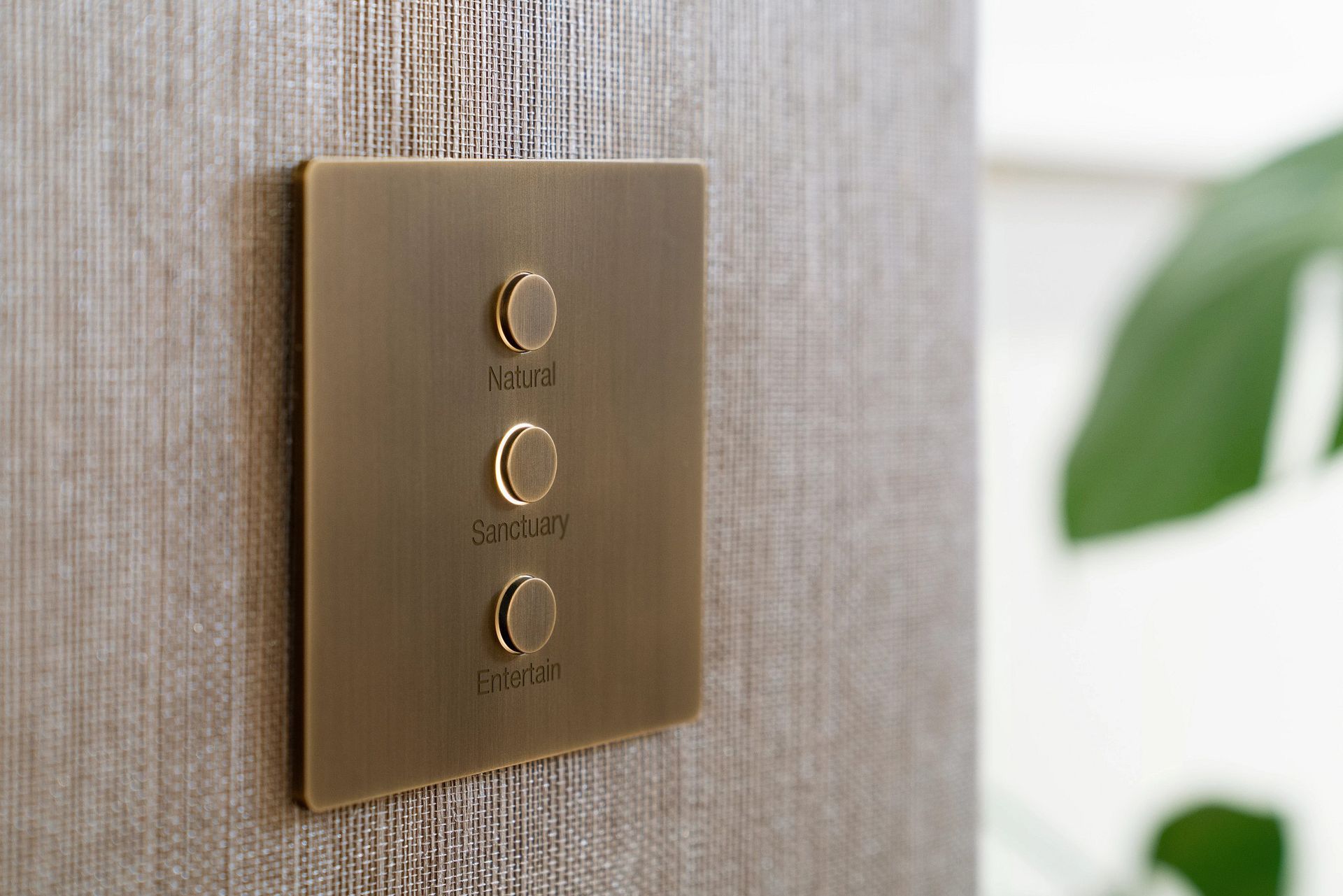
Systems such as Lutron HomeWorks can transform dozens of individual lighting loads into simple experiences and scenes.
Instead of walking through a home turning individual switches and dimmers on and off, a homeowner can select:
- Welcome
- Entertain
- Dinner
- Relax
- Movie
- Goodnight
- Away
The lighting throughout the home responds together.
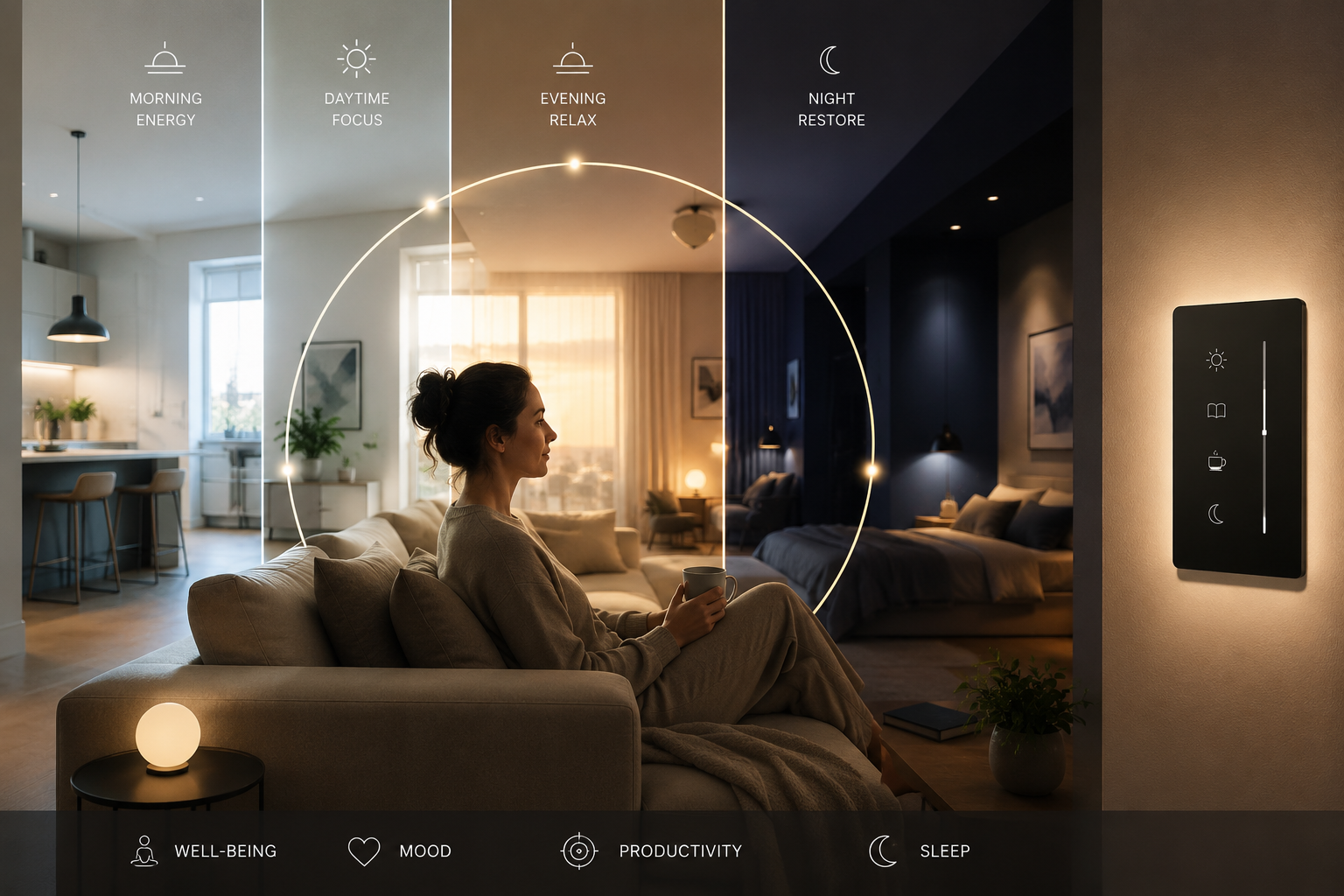
When intelligent controls are combined with technologies such as Lutron Ketra, Rania, Lumaris, and automated shading, lighting can also respond to different activities and times of day.
The result is no longer simply an electrical system.
It becomes part of the home’s architecture and experience.
Builders: Protect the Overall Quality of the Project
For builders, lighting represents an opportunity to protect the investment already being made throughout the home.


Control4 Lux vs. Lutron Intelligent Lighting: Which Luxury Lighting Solution Is Right for Your Home?